Clean Architecture
Gatherloop POS is built on Clean Architecture principles — both on the Go backend and the shared TypeScript frontend — so that business rules can be written and tested without a database, a browser, or a phone in the loop. Each side separates into three layers: Domain (what the business does), Data (where it gets its facts), and Presentation (how it's exposed or shown). Dependencies only ever point inward, toward Domain.
Backend
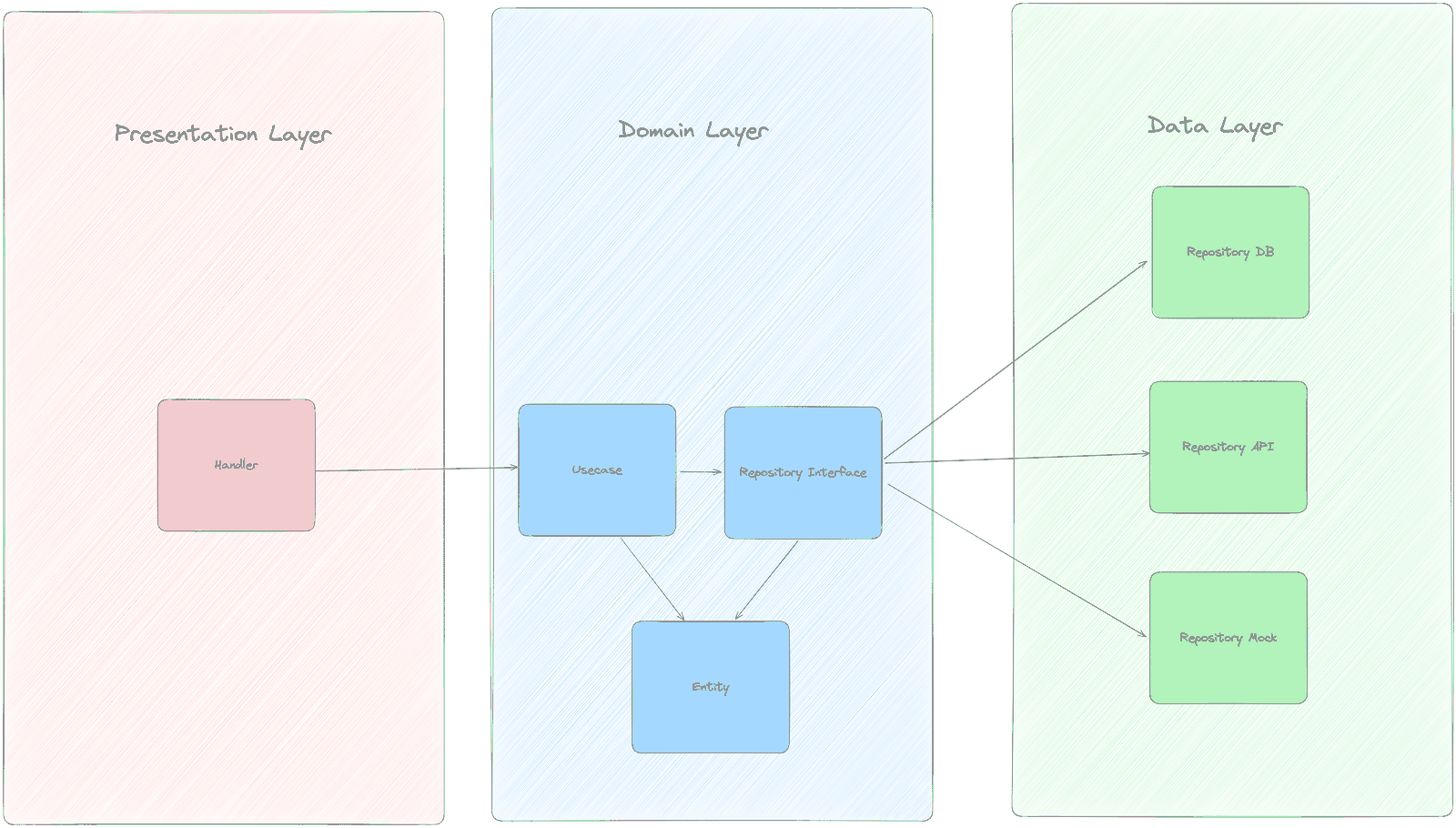
Domain layer
The core of the backend. It defines the data structures and every business rule, with no knowledge of HTTP or SQL.
- Entity — plain Go structs defining the data, e.g.
Transaction. - Usecase — the actual business logic (validating a transaction, deducting a wallet balance, recomputing a budget), e.g.
TransactionUsecase. - Repository interface — the contract a data source must satisfy, e.g.
TransactionRepository. The usecase depends on this interface, never on MySQL directly — which is what makes it possible to unit-test business logic against a mock repository instead of a real database.
Data layer
Implements the repository interfaces the domain layer requires, translating between SQL rows and domain entities. Because the domain only knows the interface, this implementation could be swapped for a different database without touching a single business rule.
Presentation layer
HTTP handlers that parse incoming requests into domain types, call the usecase, and transform the result back into JSON. This is the only layer that knows HTTP exists.
Frontend
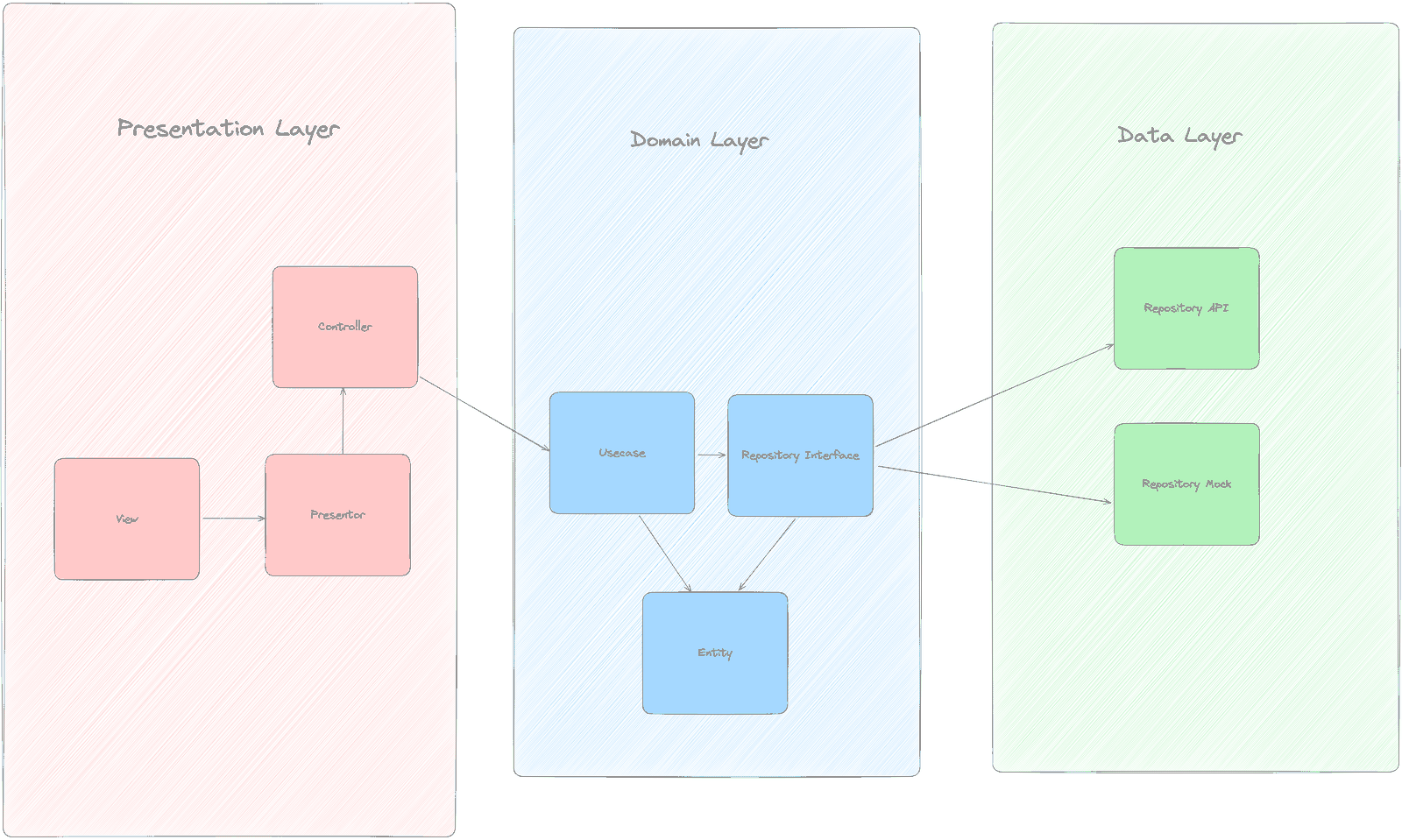
The frontend (libs/ui) mirrors the same three layers, plus a composition layer that wires them together for each screen.
Domain layer
- Entity — plain TypeScript types, e.g.
Transaction. - Usecase — business logic modeled as a finite state machine: a pure
getNextState(state, action)function, agnostic to React and to where its data comes from. See the abstractUsecasebase class every usecase implements. - Repository interface — the data contract a usecase depends on, e.g.
TransactionRepository, with real, mock, and URL-query-backed implementations satisfying it interchangeably.
Data layer
Implements the repository interfaces using the OpenAPI-generated client, translating API payloads into domain entities. A parallel mock implementation satisfies the exact same interface, which is what lets every usecase be unit-tested without a network call.
Presentation layer
The frontend presentation layer has four parts, each with one job:
- Controller — a thin hook (
useController) that plugs a usecase's state machine into React viauseReducer, e.g.useTransactionListController. - Handler — combines one or more controllers for a screen, maps domain entities to UI props, and wires cross-usecase effects (e.g. re-fetching the list after a delete succeeds). Example:
TransactionListHandler. - Screen — pure Tamagui JSX driven entirely by props, with no business logic of its own. Example:
TransactionListScreen. - App composition — the outermost piece, in
libs/ui/src/app, instantiates the real API repositories and usecases and renders the Handler.app/andpresentation/screens/each split into apos/and anorder/folder, one per app (libs/ui/src/app/pos,libs/ui/src/app/order), so a screen or composition root belongs to exactly one app. This POS example is the exact component bothapps/pos-webandapps/pos-mobileimport via@gatherloop-pos/ui/pos— see Cross-Platform (Web + Mobile) for how the same composition serves both.
Both apps/pos-web and apps/order-web are Next.js apps (Pages Router) composed identically: a page file is nothing but a getServerSideProps that resolves request-scoped data (session, route params) server-side and a default export pointing at a composition root — no JSX, no local components, no client-only gates. libs/ui/src/app/order holds four composition roots and an index.ts, the same shape as app/pos: no provider, no context, no hook, no wrapper. See docs/trd-order-app-composition-and-ssr.md for how the order app converged on this from an earlier, client-only design.
Why bother
Every layer boundary above is also a testing boundary: usecases are tested against mock repositories with no server or database (Testing Strategy), and either platform's UI can be swapped without rewriting a single business rule — which is exactly how one libs/ui codebase ends up powering both a Next.js web app and a React Native mobile app.